Friday, January 08, 2016

Comparing the Sky-Watcher 190MN Pro and Altair Wave 115ED with 0.79x Reducer/Flattener


A rare combination of clear skies, stable atmospherics and no moon last night finally provided me with an opportunity to fully test the potential of the Altair Wave 115 ED Triplet Refractor, combined with the Planostar 0.79x Reducer/Flattener - and boy was it worth the wait!

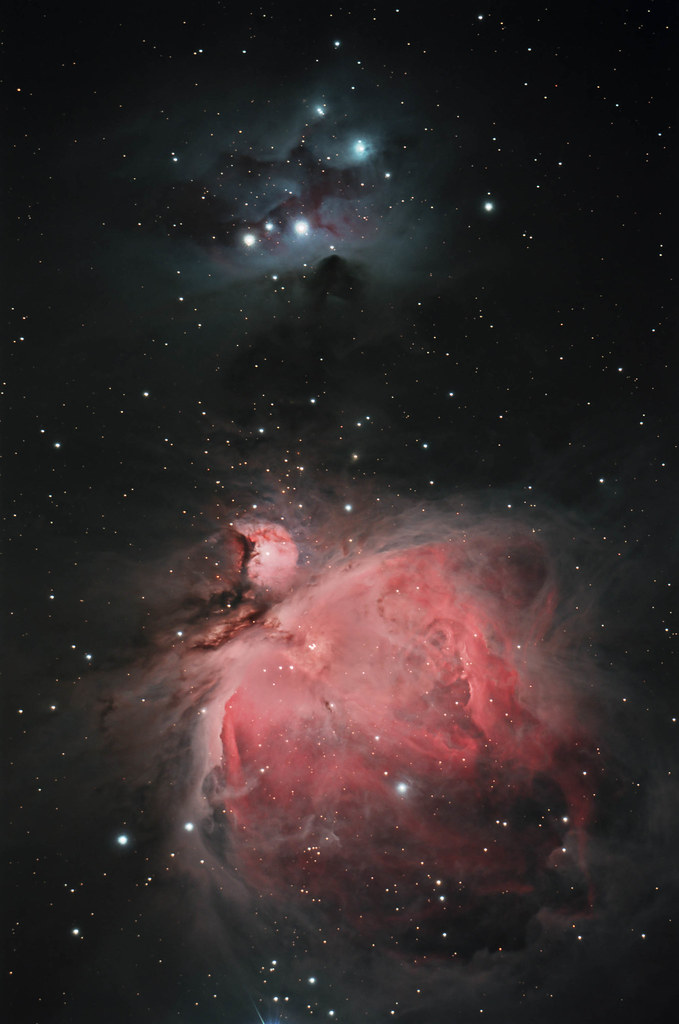
I wanted to compare the results to my previous scope - the extremely capable Sky-Watcher Explorer 190MN Pro Mak-Newtonian Astrograph.  So I chose one of my all-time favourite subjects - M42, the Great Orion Nebula and Running Man.  The image I captured using my 190MN was the first of my own astro-photos that made me go wow!  The image comprised of 10 x 300s, 10 x 200s and 25 x 45s exposures, captured and stacked using Nebulosity 3 and processed using Photoshop CS6.  The final result is now framed and has pride of place on the wall above my desk.  I was convinced it was going to be hard to beat.

My previous attempt, using the Sky-Watcher Explorer 190MN Pro
Now, before I compare the images I must point out that this is not going to be a direct, scientific comparison.  For a start, there are a couple of significant differences between the 2 scopes; FOV being the most obvious, with 1.35° x 0.9° for the 190MN Pro, vs 2.13° x 1.42° for the 115ED with the 0.79x Reducer/Flattener fitted.  The aperture being another significant difference, with the 190MN Pro being 65% larger than that of the 115ED.  The 190MN Pro is also marginally faster, with a Focal Ratio of 5.3, vs 5.53 for the 115ED.  However, I did use the same QHY8L CCD camera to capture the image and the NEQ6 mount and Lodestar XPress guide camera were also the same.

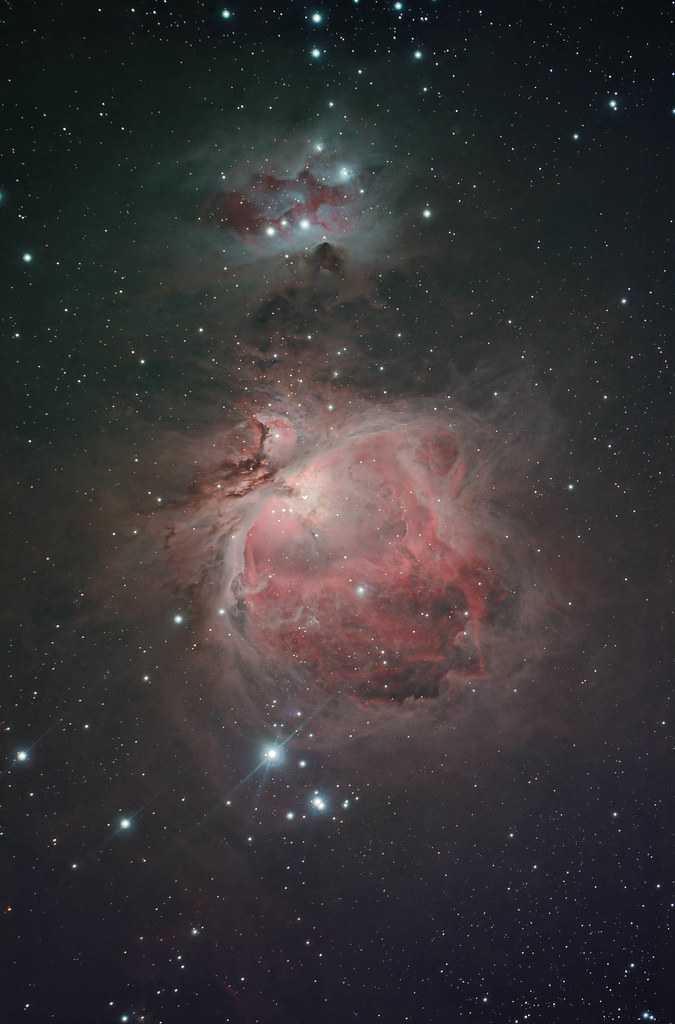
In an attempt to compensate for the smaller aperture and slightly slower Focal Ratio, I increased the length of the exposures to allow as much light to reach the camera's sensor as possible.  The final image, which you can see below, is the result of 14 x 600s and 15 x 30s exposures, captured and stacked using Nebulosity 4 and processed using Photoshop CS6.  Some may say this is an unfair comparison, but all I wanted to do was see if the Altair Wave 115ED was capable of achieving similar results to the Sky-Watcher Explorer 190MN Pro.  The answer is yes - definitely!  But that is my opinion - let me know what you think.

My latest version, using the Altair Wave 115ED and 0.79x Reducer/Flattener

Sunday, November 01, 2015

First Light With The Planostar 0.79x Reducer/Flattener


The weather wasn't brilliant on Halloween, but it was the clearest night for some time and so an ideal opportunity to test out my new Altair Planostar 3" 0.79x reducer/flattener - and what better target to choose on Halloween than the Wizard Nebula!

Once focussed, I was immediately impressed with the apparent flatness of the preview image. The stars were small bright pin pricks of light and those in the corners did not appear elongated. I chose an exposure length of 600s and set up the camera to capture a series of 15 images. When it came to processing, I had to discard 6 images due to worsening conditions as the night progressed, but in the earlier images it was evident that the faster focal length meant I was able to capture a reasonable amount of nebulosity.

NGC7380 - The Wizard Nebula
Overall I am quite pleased with the final image; especially considering the conditions. I'm sure that on another night, with better seeing, I could draw out a lot more of the fainter nebulosity, but the overall flatness of the image and nice crisp round stars proves the value of the reducer/flattener - I can't wait to try it out on a crisp and clear night.

Sunday, February 22, 2015

The Rosette Nebula


With a clear sky forecast all night last night, I decided to have a go at imaging something new last. A quick look at Stellarium showed that the beautiful NGC2237 - otherwise known as The Rosette Nebula - was perfectly positioned in the sky. So, with my son to assist, I set-up the scope and had the target centred in my field of view within 20 minutes. After ensuring the focussing was okay I initiated a series of 14 x 900s exposures, using Nebulosity 3 to control the QHY8L CCD attached to my Altair Astro Wave 115 triplet refractor. I initially tried a medium 'dither' between shots - this basically moves the scope a little between each shot to try and minimise any backlash in the mount, but it took ages to settle down for the next exposure so I cancelled that and re-started without the 'dither' option selected.

With over 3 hours of data to collect, we retired inside to keep warm and left it running. Once the imaging run was complete I decided to have a go at capturing some 'Flats'. I have not used them before, but I have a few dust spots on my optics somewhere and I was given some good advice on Stargazerslounge last week about using Flat frames to get rid of them, so I thought I'd give it a go. I don't have a light panel, but my iPad screen with a sheet of paper in-front of it to defuse the light, seemed to work well enough.

When it came to processing the image the Flats and Darks made a good job of getting rid of a lot of artifices, although there were still some that needed removing manually. It was also at this stage that I realised that having stopped the session to turn of the 'dither' option, my focussing wasn't as spot on after I restarted. As a result, the Stars were not as sharp as I would have liked. I also have doubts about the field flattener - it is probably something to do with the spacing between flattener and CCD, which needs to be accurate down to a very small tolerance - more work required there I think. However, after a little processing in Photoshop, the final result is actually fairly reasonable I think.

The Rosette Nebula (NGC2237)
The Rosette Nebula (NGC2237) - 14 x 900s, Altair Wave 115 Triplet and QHY8L


Tuesday, November 12, 2013

M42 Orion Nebula - First Light With The QHY8L


After what seemed like a long wait, I finally had a clear night this week and managed to get first light with the QHY8L that I purchased second hand on astrobuysell.com. The target was M42 (the Orion Nebula) and I have to say that I am quite pleased with the result. The image was captured using the QHY8L camera, cooled to -20 degrees, and attached to a Sky-Watcher Explorer 190MN Pro. The image consists of 10 x 200s and 10 x 45s exposures, captured using the QHY EZCAP software, with initial processing and stacking in Nebulosity 3 and final processing in Photoshop CS6. Equipment used is the Sky-Watcher Explorer 190MN Pro, mounted on a NEQ6 with a 2" Hutech IDAS LPS P2 filter to enhance contrast and reduce the effect of light pollution.

The Orion Nebula (M42)
M42 Orion Nebula

The shorter exposures were important so that the Trapezium (tight group of 4 bright stars in the core) did not become blown out. However, the longer exposures are important to capture the finer detail of the nebulosity. 

Sunday, October 06, 2013

Three Images In One Night


The trouble with being an amateur astronomer in the UK is the reliability of the weather. On more than a handful of occasions, I have spent an hour or so meticulously setting up the scope, framing my image and calibrating the guide camera, only to find the clouds have rolled in before I have managed to capture a single image.  So I could not believe my luck last night, when surprisingly, the forecast was accurate and we were blessed with an extremely clear and still night. The result was not one, but three images.

Firstly, The Ring Nebula (M57), which is a planetary nebula in the constellation of Lyra and is approximately 2,300 light years from earth. It was formed when a shell of ionized gas was expelled by a giant red star, during its dying transformation into a white dwarf. The image comprises 16 x 120s exposures.
 
The Ring Nebula (M57)

Next was Pleiades, or the Seven Sisters (M45), which is an open star cluster located in the constellation Taurus and is approximately 380 light years from Earth. This image comprises 4 x 200s exposures.

Pleiades (M45)

Finally, the most difficult of the three to capture - The Eagle Nebula (M16), which is an open star cluster and diffuse emission nebula in the constellation Serpens and is approximately 7,000 light years from Earth. Within it are several star forming gas and dust regions, including the famous 'Pillars of Creation'. This image comprises 9 x 200s exposures.

The Eagle Nebula (M16)

All three images are the result of multiple exposures, captured using my astro-moddified Canon EOS 1000D, attached to my Sky-Watcher Explorer 190MN Pro. A 2" Hutech IDAS LPS P2 filter was used to enhance contrast and reduce the effect of light pollution, which makes the faint areas of nebulosity easier to process. Once calibrated and stacked using Nebulosity 3 the images were processed using Adobe Photoshop CS6.

Considering all three images were the result of one night under the stars, I am really pleased with the outcome. Had I spent longer on each subject, in order to capture more expsoures, the result would have been even better, but that can wait for another night!